.png?width=501&height=92&name=Overtel%20Logo%20Postivo%20(7).png "Logo Corporativo Overtel Technology System S.L.")
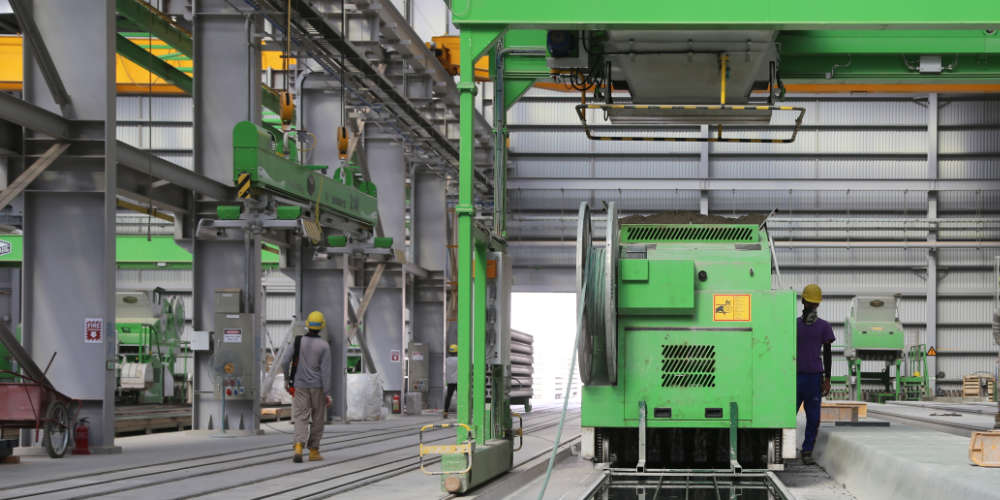
In other posts, we have talked about the OEE system and made available an Excel calculator to perform the calculation, but what is OEE really? The purpose of this post is to answer this question simply and clearly. And also, to know how it measures productivity and what is the best way to calculate it.
Table of contents
- What is OEE, and how does it measure productivity?
- How to calculate OEE
- How to calculate OEE in your company
What is OEE, and how does it measure productivity?
OEE (Overall Equipment Effectiveness) is the gold standard for measuring manufacturing productivity. Simply put, it identifies the percentage of manufacturing time that is actually productive. An OEE score of 100% means you are making only good parts, as fast as possible, with no downtime. In OEE parlance, that means 100% quality (only good parts), 100% throughput (as fast as possible) and 100% availability (no downtime).
Measuring OEE is a manufacturing best practice. By measuring OEE and the underlying losses, you will gain important information on how to systematically improve your manufacturing process. OEE is the best metric for identifying losses, assessing progress and improving the productivity of manufacturing equipment (i.e., eliminating waste).

How to calculate OEE?
There are two ways to calculate it: the simple calculation and the preferred one. We will see below what they mean and why we chose the preferred one:
SIMPLE CALCULATION
The simplest way to calculate OEE is the ratio of total productive time to planned production time. Fully productive time is just another way of saying that you manufacture only good parts as fast as possible (ideal cycle time) and with no downtime. Therefore, the calculation is:
OEE = (good parts × ideal cycle time) / planned production time.
Although this is a fully valid OEE calculation, it does not provide information on the three loss-related factors: availability, throughput and quality. For that, we use the preferred calculation.
PREFERRED CALCULATION
The preferred OEE calculation is based on the three OEE factors: availability, throughput and quality.
Calculate the overall equipment effectiveness by multiplying availability, throughput and quality
OEE is calculated by multiplying the three OEE factors: availability, performance and quality.
Availability
Availability takes into account all events that stop planned production long enough to record the reason for being idle (usually several minutes).
Availability is calculated as the ratio of run time to planned production time:
Availability = run time / planned production time.
The runtime is simply the planned production time minus the downtime, where downtime is defined as all the time in which the production process was intended to run, but was not due to unplanned stops (e.g. breakdowns) or planned stops (e.g. changeovers).
Run time = planned production time - downtime
Yield
Throughput takes into account everything that causes the manufacturing process to run at less than the maximum possible speed when it is running (including slow cycle times and small stops).
Examples of factors that generate a yield loss include machine wear, poor materials, jams and jams.
Throughput is the ratio of net run time to run time. It is calculated as:
Throughput = (ideal cycle time × total parts) / run time.
The ideal cycle time is the fastest cycle time that your process can achieve under optimal circumstances. Therefore, when multiplied by the total count, the result is the net run time (the fastest possible time to manufacture parts).
Since rate is the reciprocal of time, throughput can also be calculated as:
Yield = (total parts / run time) / ideal run rate.
The yield should never be greater than 100%. If it is, it usually indicates that the ideal cycle time is set incorrectly (it is too high).

Quality
Quality takes into account manufactured parts that do not meet quality standards, including parts that need repairs. Therefore, we refer to good parts as parts that successfully pass through the manufacturing process the first time without rework.
Quality is calculated as:
Quality = Good Parts / Total Parts.
This is the same as taking the ratio of total productivity time (only good parts produced as fast as possible with no downtime) to net run time (all parts produced as fast as possible with no downtime).
Calculating OEE
OEE takes into account all losses, resulting in a measure of truly productive manufacturing time. It is calculated as:
OEE = Availability × Throughput × Quality
If the Availability, Yield and Quality equations are substituted into the above and reduced to their simplest terms, the result is:
OEE = (good parts × ideal cycle time) / planned production time.
This is the "simpler" OEE calculation described above. And, as described above, multiplying the good count by the ideal cycle time results in a fully productive time (making only good parts, as fast as possible, with no downtime).
Why the preferred OEE calculation?
OEE scores provide valuable information: an accurate picture of how efficiently your manufacturing process is running. And it makes it easy to track improvements in that process over time.
What your OEE score does not provide is information about the underlying causes of productivity loss. This is the role of availability, throughput and quality.
In the preferred calculation, you get the best of both worlds. A single number that captures how well you are doing (OEE) and three numbers that capture the fundamental nature of your losses (availability, throughput and quality).
How to calculate OEE in your company
As we have seen, for a successful calculation, we need to provide all the data in detail so that the calculation, in addition to giving us a productivity result, shows where the source of the losses is. Therefore, the key lies in recording all the data, even by machine, and doing it automatically.
There is a manual way to do the calculation, using an Excel calculator, like the one we share for free in our resources. This way, you can calculate the OEE correctly, but it does not take into account all the data, such as the individual efficiency of each machine. In addition, entering the data by hand in a file results in a slow and tedious process when you have to do it regularly.
Therefore, we have to look for an automated way to collect the data and perform the calculation.
This is achieved through an MES system. A system that collects the detailed data, takes into account the most important parameters related to efficiency and presents the exact results, allowing you to correct any faults that may be affecting the overall performance of the factory. In addition, an MES system not only allows you to optimise OEE but also to automate your factory in every aspect. For more information about the MES system, check this post.
At Overtel, we are the developers of a complete MES system, and we perform the integration in the production plant to make it really functional. We invite you to learn about our MES DAT PRO system.
Just contact an expert, and he will be happy to talk to you about how it works.
Content developed based on the methodology explained by OEE in “Calculating OEE” (oee.com).