.png?width=501&height=92&name=Overtel%20Logo%20Postivo%20(7).png "Logo Corporativo Overtel Technology System S.L.")
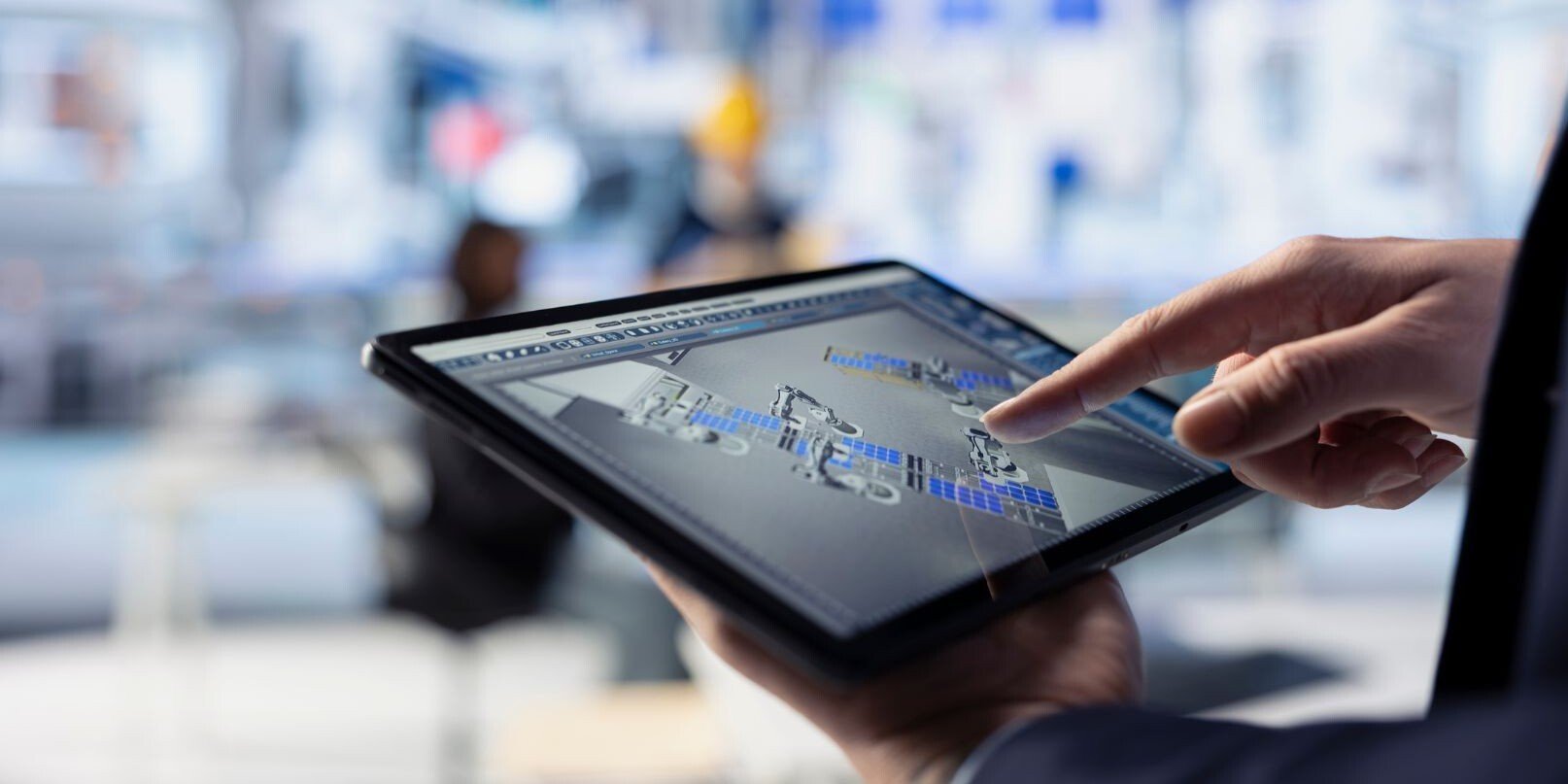
In the context of Industry 4.0, repetitive manufacturing vs. flexible production has become one of the most relevant comparisons to define the production strategy of modern factories.
Table of contents:
- . What are repetitive manufacturing and flexible production?
- Key differences between repetitive manufacturing and flexible production.
- Advantages and limitations of each model
- How to combine the best of both worlds: the hybrid 4.0 model.
- Digitalization and automation: the meeting point
While repetitive manufacturing seeks maximum efficiency in large volumes of standardized products, flexible production pursues adaptability, customization and speed in the face of market changes .
Today, thanks to industrial digitalization and the integration of MES systems such as INEXION, both models can coexist under a hybrid approach that combines productivity, traceability and operational agility.What are repetitive manufacturing and flexible production?
Definition and evolution of both models
Repetitive manufacturing is based on producing large volumes of identical products continuously or in very similar cycles. This approach prioritizes operational efficiency, quality control and unit cost reduction. It is typical of sectors such as automotive, consumer electronics or industrial food .
Flexible production , on the other hand, was born as a response to the need to adapt production to variable demand. It allows different products to be manufactured on the same line by means of versatile machinery, multi-purpose equipment and dynamic planning. It is the basis of the Just in Time model promoted by Toyota and today evolved into Smart Manufacturing.
From the Toyota model to automated flow 4.0
The Toyota system introduced the idea that producing less, but better, could generate more value. With the advent of industrial automation, IoT sensors and finite scheduling systems, flexibility is no longer a handicap but a driver of competitiveness.
Today, smart factories integrate both approaches: software-optimized repetitive lines and flexible modules capable of adapting to customized orders.
Your role in the industrial digital transformation
Digital transformation has redefined the boundaries between the two models. MES solutions such as INEXION make it possible to connect equipment, operators and processes in real time, collecting performance (OEE), availability and quality data, essential for measuring the profitability of each production order.
Key differences between repetitive manufacturing and flexible production
At the operational level, the two models differ in their purpose and degree of standardisation.
Workflow, customisation and automation
| Feature | Repetitive Manufacturing | Flexible Manufacturing |
| Flow type | Continuous and stable | Adaptive and variable |
| Customization | Minimal, standard products | High, configurable products |
| Automation | High, focused on specific tasks | Flexible, with reprogrammable equipment |
| Inventory | Just in Stock | Just in Time |
| Quality Control | Uniform and automatic | Dynamic and variation-oriented |
| Ideal for | Consumer goods, electronic components | Short runs, customised products |
Scalability, cost and lead times
Repetitive manufacturing thrives in high-demand environments with stable forecasting, as the cost per unit decreases as volume increases.
In contrast, flexible production offers shorter turnaround time, but requires digital planning and intelligent automation to maintain profitability.
Efficiency vs. adaptability: a question of balance
The most competitive companies will be those that manage to balance both approaches, combining repeatable efficiency and flexible agility. This is the principle of the hybrid digital manufacturing model, which integrates data, planning and traceability into a single connected platform.
Advantages and limitations of each model
Repetitive manufacturing: efficiency, quality and control
| Advantages | Limitations |
| High productivity and production speed. | Low adaptability to product changes. |
| Low unit costs. | High initial investment in fixed automated lines. |
| Standardized quality control. | Risk of overproduction if demand varies. |
| Predictability in planning and supply. |
Flexible production: customisation and market responsiveness
| Advantages | Limitations |
| Adaptability to demand and customised orders. | Requires high personnel training. |
| Less waste due to Just in Time philosophy. | Greater complexity in planning. |
| Ability to work with small or customised batches. | Initial costs in automation and management software. |
| Natural integration with Lean Manufacturing methodologies. |
Challenges to maintain the balance
The great challenge for production managers today is to achieve a point of convergence: an efficient, standardised and, at the same time, adaptable operation.
This is where digitisation and the use of MES systems become the key to success.

How to combine the best of both worlds: the hybrid 4.0 model.
Data integration, finite planning and digital traceability
The hybrid 4.0 model connects the stability of repetitive manufacturing with operational flexibility through digital tools.
Thanks to finite planning, the system can simulate workloads, changeover times or machine availability, adjusting the optimal sequence to maximise overall efficiency.
With INEXION, this planning is linked to actual plant data: energy consumption, downtime or maintenance incidents, all visible on real-time OEE dashboards.
How MES systems achieve flexibility without losing efficiency
An MES system acts as the operational brain between the ERP and the shop floor. It allows you to manage orders, batch traceability, shutdowns and maintenance without losing control or stability.
Practical example: A food company with repetitive lines can use INEXION to automatically adjust production according to the day's demand, modifying batches or formulations without interrupting the line.
Hybrid model example: adaptable repetitive lines
- Automotive: repetitive chassis production with customisation modules (colour, interiors, software).
- Cosmetics: flexible lines capable of changing packaging or fragrances in minutes.
- Electronics: repetitive manufacturing of motherboards with flexible assembly of final components.
Digitalisation and automation: the meeting point
The role of MES in order, time and maintenance management.
A modern MES centralises all operational information: production orders, changeover times, energy efficiency and predictive maintenance.
Thanks to its integration with IoT sensors and PLCs, it collects automatic data and generates early warnings of performance deviations.
ERP + MES + IoT integration: total plant visibility
ERP + MES + IoT integration creates a bidirectional information flow:
- ERP plans and launches orders.
- The MES executes, controls and feeds back.
- IoT devices capture real-time data from equipment and operators.
With Overtel's INEXION MES, this structure is transformed into a single digital platform that allows you to control OEE, traceability, downtime and costs per batch automatically.
Controlled, agile, traceable production
The key to the smart factory is total visibility. With visual dashboards and dynamic reports, INEXION enables data-driven decision making, resource optimisation and anticipation of incidents before they affect production.
The future of industrial production is not about choosing between repetitive or flexible manufacturing, but about integrating both under an intelligent digital approach.
With the MES INEXION system, Overtel is driving this transformation, helping industrial companies connect planning, maintenance and production in real time.
Contact us and discover how to combine efficiency and agility in your production model.